Why This Pulse Feels Personal: The Data and Logic Behind Lasso Insights
A deep dive into how Lasso turns one activity into a personalized pulse using your history, effort context, and progression signals.
Introduction
A good training insight should feel specific, not generic. "Nice run" is easy to generate, but it does not help you improve. Lasso's personal activity pulse is built to answer a harder question: what does this activity mean for you, right now, based on your recent training and goals?
Instead of looking at one workout in isolation, we combine activity metrics, sport-specific derived data, your recent history, and contextual signals (like location or weather) to generate a short pulse focused on progression.
What You See in the Pulse
The personal pulse is designed to be quick to read but information-dense: a concise summary, a small set of notable insights, and recommendations only when confidence is high.
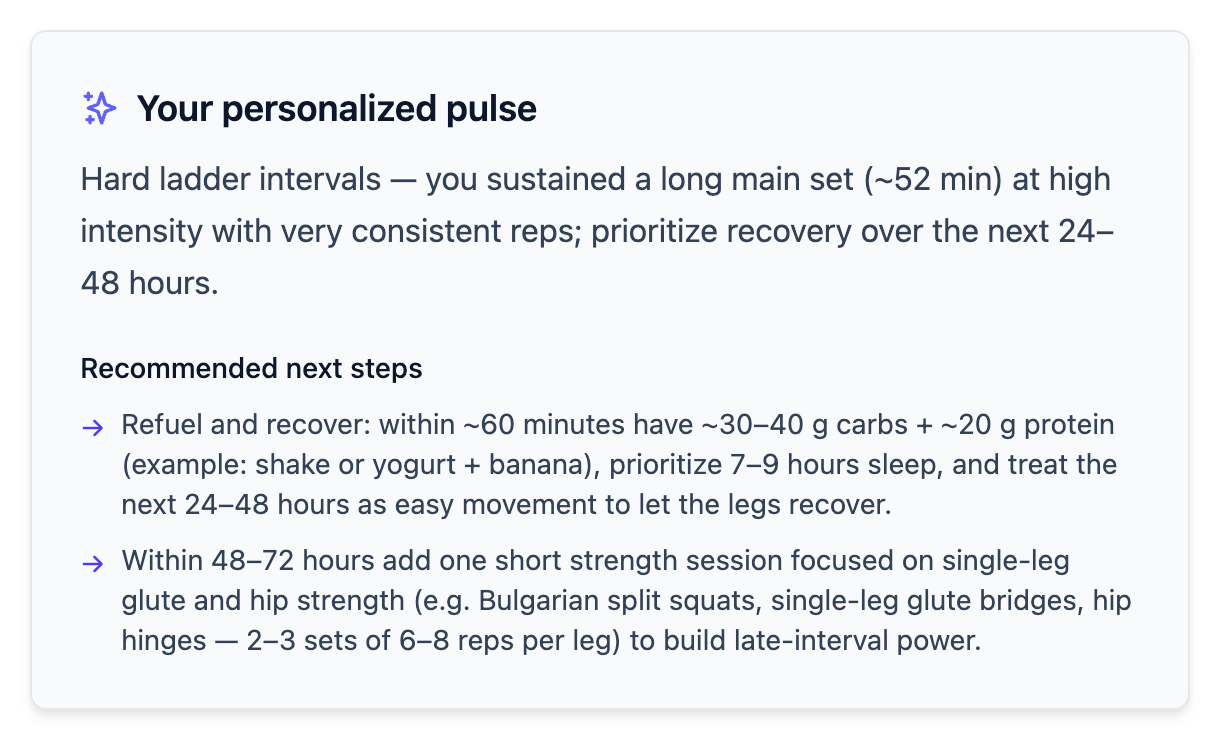
In practice, this means the pulse should help you understand whether the session supported recovery, aerobic development, threshold work, race prep, or another training intent.
The Inputs Behind a Personal Pulse
The pulse combines multiple data layers so the analysis is grounded in context, not a single number:
- Focus activity data: sport, duration, pace or speed, elevation, power, heart rate, race or track flags, and title/context notes.
- Sport-specific derived metrics: values like RPE, pace drift, threshold heart rate, heart rate recovery, and FTP-related signals when available.
- Recent history: same-sport and all-sport lookback windows, including training frequency and progression trends.
- Comparisons: same-route and same-workout matching to compare today against similar efforts.
- Context blocks: lap summaries, segment efforts, location, weather, vitals, and recent pulse history to avoid repetitive recommendations.
- Goal context: active user goals and available progress signals to frame advice toward what matters most right now.
Effort-Aware Interpretation
One of the most important parts of the pulse is effort classification. Structured workouts are not always hard workouts. For example, interval patterns can still be part of an easy aerobic day.
Lasso prioritizes physiological effort signals (like heart rate relative to threshold context) and then cross-checks workout structure, pace, power, and notes. This helps keep recommendations aligned with intent:
- Easy and recovery sessions are treated as purposeful, not "missed hard days."
- Hard sessions are evaluated for progression, consistency, and fatigue cost.
- Race-tagged activities are interpreted as peak efforts with recovery-aware follow-up.
- Track sessions can trigger lap-level pacing and consistency analysis.
Insight Generation and Recommendation Quality
We aim to generate fewer, better insights rather than fill space with weak observations. If a metric is effectively unchanged versus recent history, it should usually be omitted instead of presented as artificial signal.
Recommendations are also gated. Lasso only includes them when there is enough confidence that the suggestion is relevant and timely for your current load and recent pattern.
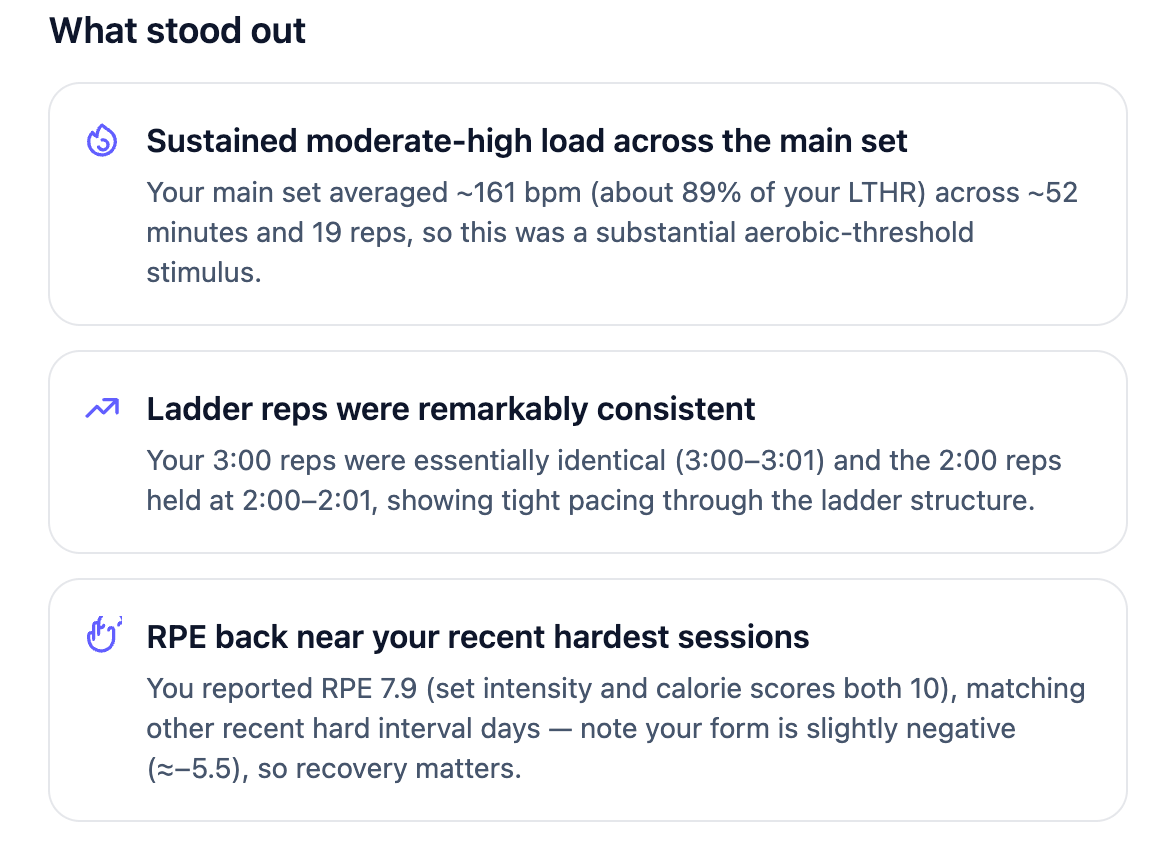
This keeps your pulse feed useful over time, with less repetition and more actionable guidance.
Why This Matters for Training
Training quality compounds when feedback is both specific and consistent. A personalized pulse helps close the loop between what you planned, what you did, and what to do next.
- Better day-to-day decisions: clarity on whether to push, maintain, or recover.
- Stronger progression awareness: trend-based interpretation rather than one-off judgments.
- Less noise: fewer generic tips, more context-aware guidance.
- Sport-specific value: insights adapt to the activity type and available data.
Limitations and Data Requirements
Personal pulses improve as your data quality improves. Sparse history, missing heart rate or power streams, and inconsistent activity metadata can reduce the depth of analysis.
- Some metrics are only available for specific sports or devices.
- Comparisons are strongest when similar historical efforts exist.
- Recommendations may be omitted when confidence is low, by design.
Conclusion
The personal activity pulse is built to be your training context engine: short, readable, and grounded in your own history. By combining effort interpretation, progression signals, and context-aware recommendations, Lasso turns routine activity data into feedback you can actually use.