From 400s to 5-Minute Reps: Inside Lasso's Track Workout Detection
How Lasso separates distance intervals from time intervals, detects real workout structure, and turns laps into better progression analysis.
Why Workout Structure Matters
A track workout is not just "a run with laps." The structure matters. 8x400, 6x800, and 5-minute on/off ladders all train different systems, and your progression only makes sense when today's workout is compared to similar sessions.
Lasso's track analysis pipeline is built to detect this structure automatically, then use it for lap-level insights and matched workout comparisons.
Step 1: Filter Out Auto-Lap Noise
Many watches create automatic laps every mile or kilometer. Those are useful for pacing, but they are not the same as intentional interval blocks.
Lasso first checks for auto-lap patterns and skips them for interval detection. In practice, if most laps match standard auto-lap distances (1 mile or 1 km), we treat that as auto-splitting rather than workout structure.
This is a key quality gate: it prevents normal steady runs from being misclassified as interval workouts.
Distance Intervals vs Time Intervals
Lasso supports both common interval formats, but the detection logic is different for each.
Distance-based intervals
For sessions like 400m repeats or 800m repeats, Lasso reads lap distances and normalizes them to standard track-oriented buckets. Distances are accepted only when they are close enough to a known standard (for example, 785m can map to 800m, while 750m is too far off and is dropped).
This normalization is what lets "messy real-world GPS laps" still line up as a comparable workout signature like 6x800, 4x400.
Time-based intervals
For workouts written as minutes (for example, "5min on, 5min float, 4min on..."), distance is often variable and less meaningful as the primary key.
Lasso detects time-based interval intent from the activity title and description, then stores lap structure by duration instead of standardized distance. Durations are snapped to clean minute blocks when they are close enough to expected values (for example, 239s becomes 240s).
This gives you better analysis for sessions where effort timing is the plan, not exact meters.
Step 3: Build the Matched Workout Signature
Once interval blocks are extracted, Lasso builds a canonical signature for the main set. That signature is used to match today's workout with previous sessions of the same structure.
- Main set focus: warm-up and cooldown laps are excluded when available, so matching centers on the quality work.
- Consecutive grouping: repeated lap types are grouped into compact blocks, such as
6x800. - Pattern-aware matching: mixed sets remain mixed (for example,
6x800, 4x400) rather than collapsing into one bucket.
Step 4: Lap-Level Analysis in the UI
The matched workout view is where this data becomes useful. Instead of a single average pace for the whole run, you can compare workout-to-workout performance by block.
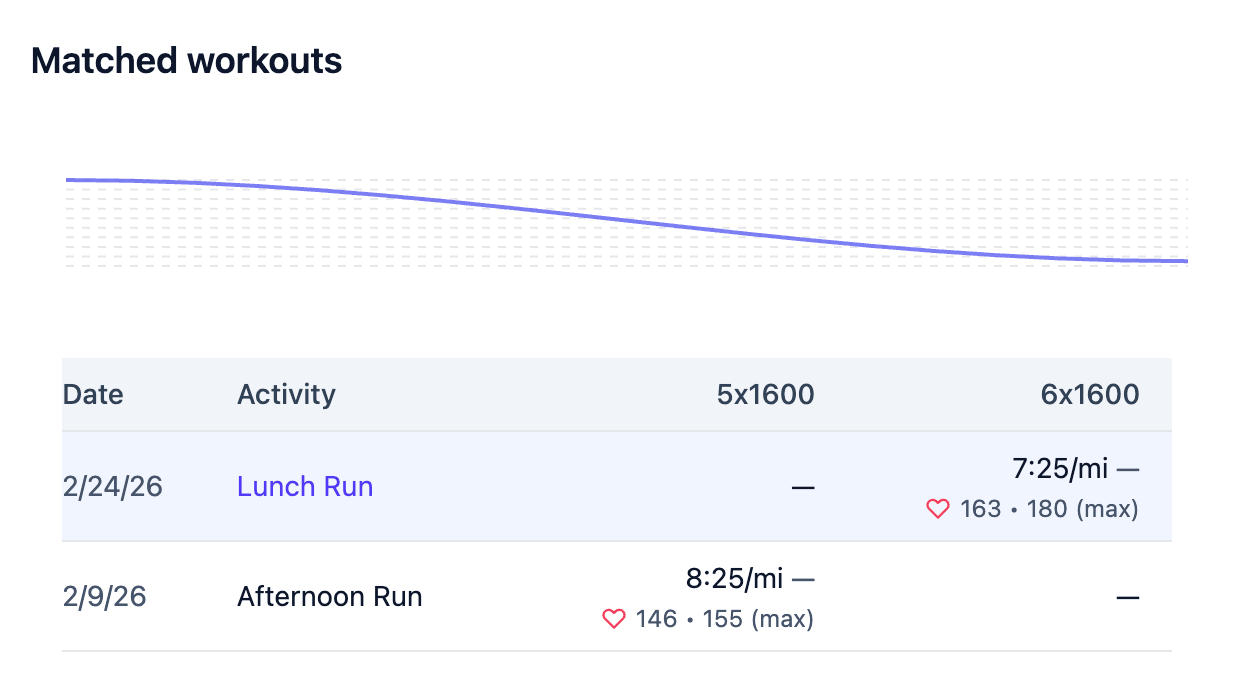
For each matched workout, Lasso can show:
- main set pace trend over time,
- per-block pace differences versus average,
- average and max heart rate by lap block, and
- clear side-by-side progression for similar sessions.
Why This Improves Analysis Quality
Without structure detection, two workouts can look similar on paper but be very different in training effect. A 45-minute run with 5-minute reps should not be analyzed the same way as a steady easy run, and 6x800 should not be merged into generic pace stats.
By identifying interval type first, Lasso can generate more accurate comparisons, cleaner trend lines, and better pulse insights tied to the actual intent of the session.
Limitations and Edge Cases
- Missing or sparse lap data reduces structure detection quality.
- Unstructured fartlek sessions may only partially map to a clean signature.
- Very noisy GPS distance can cause interval drops when laps are far from known distance standards.
- Time-interval detection depends on enough minute-based cues in title or notes.
Conclusion
Track workout analysis gets more useful when the system understands what kind of intervals you actually did. Lasso's approach separates distance and time interval logic, filters out auto-lap noise, and builds lap-level comparisons that make progression obvious from one quality session to the next.